United States · The Courts
Supreme Court Strikes Louisiana District, Narrowing Voting Rights Act
In a 6-3 ruling, the justices said the state’s second majority-Black congressional seat was an unconstitutional racial gerrymander; Congress’s law, the dissent said, is now nearly toothless.
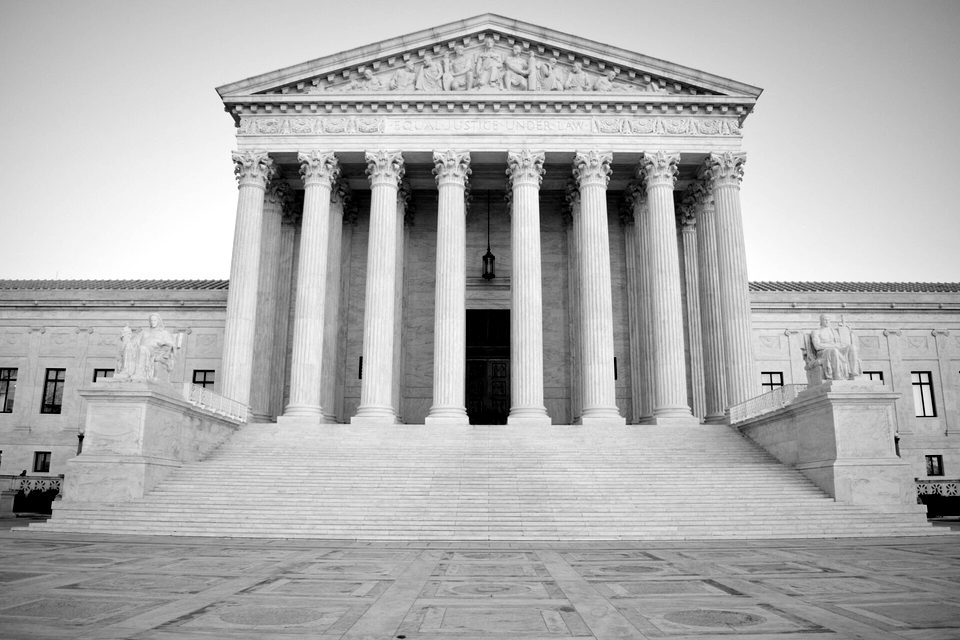

The Supreme Court ruled 6-3 on Wednesday that Louisiana’s congressional map, which contained a second majority-Black district, was an unconstitutional racial gerrymander, and in doing so made it considerably harder to use Section 2 of the Voting Rights Act to challenge maps. Justice Samuel Alito wrote the majority opinion in Louisiana v. Callais, joined by Chief Justice John Roberts and Justices Clarence Thomas, Neil Gorsuch, Brett Kavanaugh and Amy Coney Barrett. Justice Elena Kagan dissented, joined by Justices Sonia Sotomayor and Ketanji Brown Jackson, according to a summary by the law firm Faegre Drinker.
Louisiana’s 2021 plan created one majority-Black district among six, Scripps News reported. Lower courts found that it violated Section 2, and lawmakers then drew a second majority-Black district. A group of voters then challenged that second district in court.
Alito wrote that because the Voting Rights Act did not require the second district, nothing justified the state’s use of race in drawing it. Faegre Drinker’s summary said the opinion sets a three-part standard for challengers: they must show an alternative map that meets the state’s legitimate goals without using race, their analysis of voting patterns must account for party affiliation, and they need evidence with more than a remote bearing on present-day intentional discrimination. “Simply pointing to inter-party political polarization,” the summary says of the Court’s view, “proves nothing.” Ballotpedia quoted the opinion as saying Section 2 requires evidence giving rise to a strong inference of intentional discrimination. Scripps News reported that Alito wrote that minority voters should not be treated differently from other voters, a position that supporters of the ruling say follows from the Constitution’s promise of equal treatment.
Kagan wrote that the consequences were likely to be “far-reaching and grave” and that the decision renders Section 2 “all but a dead letter,” Ballotpedia reported, and Scripps News quoted her saying: “I dissent because Congress elected otherwise.” Scripps News also quoted her saying the court “betrays its duty to faithfully implement the great statute Congress wrote.”
Democrats condemned the decision. Former President Barack Obama said it guts a key pillar of the Voting Rights Act, according to Scripps News, and Sophia Lin Lakin of the ACLU’s Voting Rights Project called Section 2 the shield against discriminatory maps. Louisiana’s governor, Jeff Landry, and attorney general, Liz Murrill, said the state is working with the Legislature and the secretary of state on a path forward, and Landry argued that drawing districts for political reasons is a prerogative of the states, Ballotpedia reported.
The practical effects are already being weighed. Under the 2022 map Louisiana’s delegation was five Republicans and one Democrat; under the map the Court struck down it was four and two, Ballotpedia said. Scripps News noted that courts have allowed partisan gerrymandering and that Black voters in Louisiana overwhelmingly favor Democrats while white voters tend to favor Republicans, so the ruling could let other states redraw lines to the advantage of Republicans.
Ballotpedia reported that Alabama’s governor, Kay Ivey, said she would not immediately call a special session, citing a court order barring new districts there until after the 2030 census, and that Mississippi’s governor has called a special session on congressional redistricting beginning May 20, though a new map there would almost certainly not apply to this year’s midterms. Florida’s Legislature has already approved a new map, and six states will use new congressional boundaries in 2026, the outlet said. The general election is Nov. 3.
Sources
- Faegre Drinker, Apr. 2026: vote breakdown, Alito’s holding, three-part test for Section 2 challengers, Thomas concurrence <https://www.faegredrinker.com/en/insights/publications/2026/4/supreme-court-decides-louisiana-v-callais>
- Ballotpedia News, Apr. 29, 2026: 6-3 ruling, strong inference of intentional discrimination, Kagan dissent, Landry and Murrill statement, 2022 and current map delegations, Alabama and Mississippi reactions, Florida map <https://news.ballotpedia.org/2026/04/29/u-s-supreme-court-decides-prominent-redistricting-case-with-implications-for-future-map-changes/>
- Scripps News, Apr. 29, 2026: background of Louisiana’s maps, Alito’s equal-treatment reasoning, Kagan quote, Obama and ACLU reaction, partisan implications <https://www.scrippsnews.com/politics/supreme-court/supreme-court-backs-gop-in-louisiana-redistricting-limiting-black-voters-influence>
This article was drafted with automated tools from the sources listed, checked by a review pass, and published by Daniel Varrone. Corrections: editor@monochromechronicles.com