Science · Astronomy
Astronomers Report a Thin Atmosphere on a Small World Beyond Pluto
Japanese observers saw a star fade gradually, rather than blink out, as the icy object passed in front of it; outside experts say the result needs confirmation.
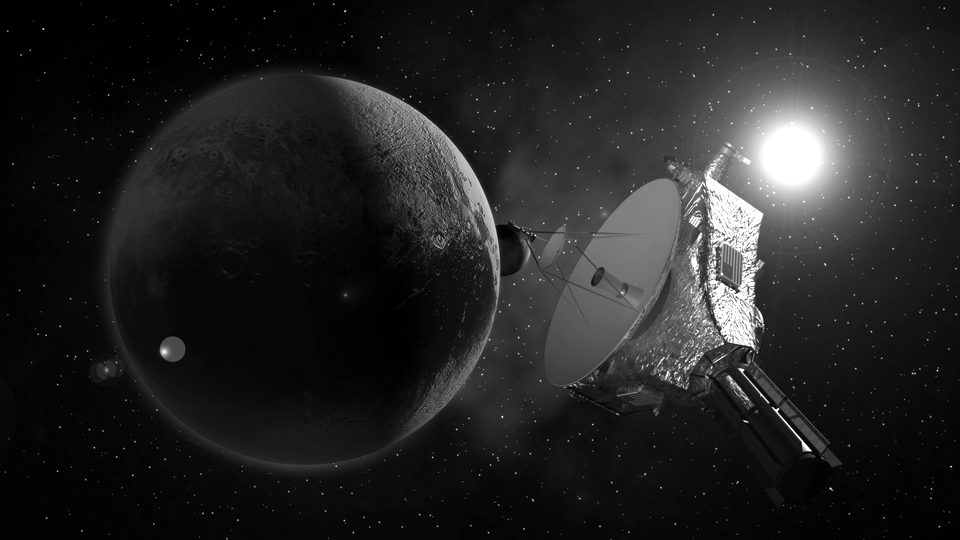

Astronomers in Japan report that a small icy world beyond Pluto appears to have an atmosphere, a surprise because bodies that small are not expected to hold onto gas. The finding, published Monday in the journal Nature Astronomy, concerns an object designated 2002 XV93, which CBS News described as a “mini Pluto” roughly 300 miles across. If confirmed, it would be only the second world beyond Neptune known to have an atmosphere, after Pluto.
The evidence comes from a stellar occultation, in which a distant star’s light is dimmed as an object passes in front of it. On Jan. 10, 2024, telescopes at three locations in Japan watched 2002 XV93 cross a background star, according to CBS News and Science News. Without an atmosphere, the star would have winked out and reappeared abruptly. Instead its light faded and recovered gradually over about 1.5 seconds, which the authors read as starlight bending through a thin layer of gas, Science News reported.
Ko Arimatsu of the National Astronomical Observatory of Japan led the work, which the National Astronomical Observatory of Japan and partner institutions also described in a release. The team included professional and amateur Japanese astronomers. Arimatsu told Science News he was “genuinely surprised,” and said, “Until now, Pluto was the only trans-Neptunian object with a confirmed atmosphere.”
The atmosphere would be extremely thin, about one ten-millionth of Earth’s surface pressure, according to Science News, or 50 to 100 times thinner than Pluto’s, according to CBS News. It could not support life. Candidates for the gas include methane, nitrogen and carbon monoxide, CBS reported, though the data do not reveal the composition or how high it extends.
Gravity on so small a body should let such an atmosphere leak away. The observatory said calculations suggest it would last less than 1,000 years unless replenished, and Science News said thousands of years, so either way it must have formed or been refreshed recently. Two explanations are proposed: gas vented from the interior by ice volcanoes, or gas released by a comet impact. Observations with the James Webb Space Telescope show no sign of frozen gases on the surface that could sublimate into an atmosphere, the observatory said, and it added that more observations are needed to tell the scenarios apart. Arimatsu told Science News that if the atmosphere fades over the next few years it may have been temporary, while persistence would favor volcanic venting.
Scientists not involved in the study urged caution. Alan Stern of the Southwest Research Institute, lead scientist for NASA’s New Horizons mission to Pluto, told CBS News the finding “sorely needs independent verification” and that “the implications are profound if verified.” Jose-Luis Ortiz told CBS he still doubts it is an atmosphere, suggesting a ring close to the body; Arimatsu said a nearly edge-on ring does not fit the main features of the observations.
Science News noted that a single occultation cannot completely rule out alternatives such as dust, and CBS reported that astronomers called for more observations, especially with the Webb telescope.
Sources
- National Astronomical Observatory of Japan, May 5, 2026 (later source): observation date, team, atmospheric lifetime, proposed explanations, Webb telescope observations <https://www.nao.ac.jp/en/news/science/2026/20260505-prc.html>
- CBS News, May 4, 2026: Nature Astronomy publication, mini Pluto description, comparison with Pluto’s atmosphere, possible gases, Stern and Ortiz comments <https://www.cbsnews.com/news/mysterious-world-beyond-pluto-atmosphere-study/>
- Science News, May 4, 2026: occultation details, gradual fading over about 1.5 seconds, pressure, Arimatsu quotes, caveats <https://www.sciencenews.org/article/atmosphere-small-object-past-pluto>
This article was drafted with automated tools from the sources listed, checked by a review pass, and published by Daniel Varrone. Corrections: editor@monochromechronicles.com