Science · Astronomy
NASA’s Roman Space Telescope Launches Aboard a Falcon Heavy from Florida
The infrared observatory, built to map the cosmos and probe dark energy, began a trip of about 100 days to a vantage point 1.5 million kilometers from Earth, AFP reported.
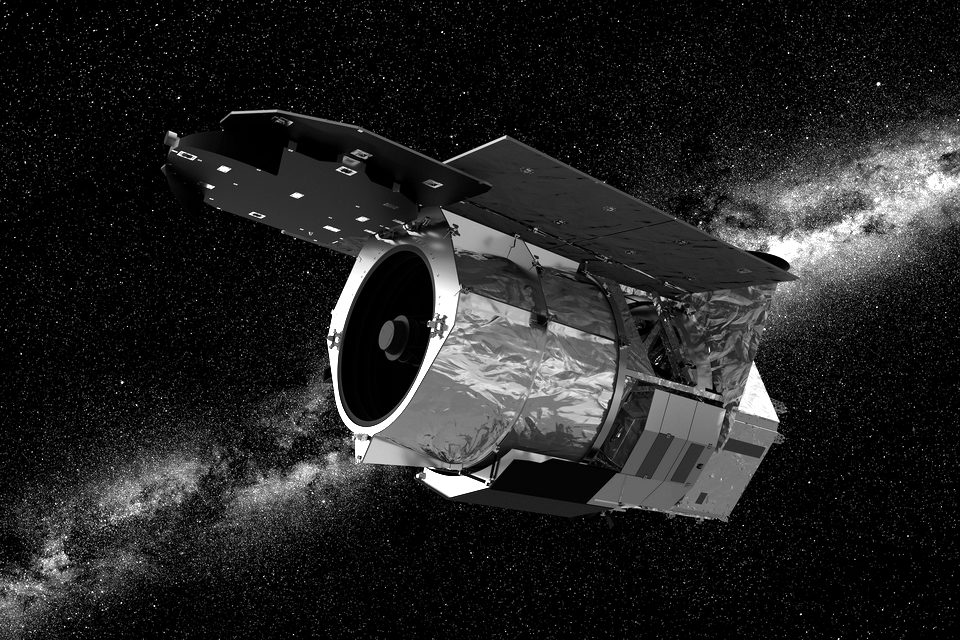

NASA’s Nancy Grace Roman Space Telescope lifted off on Sunday aboard a SpaceX Falcon Heavy rocket from Kennedy Space Center in Florida, beginning a multi-year mission to survey the sky in infrared light. Space.com’s headline described the launch as a success, and AFP, in its pre-launch report, put the planned liftoff at 7:26 a.m. Eastern time.
According to AFP, the observatory stands more than 12 meters, or 39 feet, tall and took over a decade to build at a cost topping $4 billion. It is named for Nancy Grace Roman, known as the “Mother of Hubble.” The telescope is headed for a vantage point 1.5 million kilometers, or 930,000 miles, from Earth, and the trip will take about 100 days.
What makes Roman distinctive is its view. AFP reported that its field of view is more than 100 times larger than Hubble’s and significantly wider than that of the James Webb Space Telescope. It sees in infrared, which lets it detect very old light, and it is expected to generate about 1.3 terabytes of data a day.
The mission’s goals, as AFP summarized them, are to find thousands of exoplanets and tens of thousands of supernovae and to study dark matter and dark energy, which together make up about 95 percent of the universe. Roman is intended to work alongside Webb, the Vera C. Rubin Observatory in Chile and the European Space Agency’s Euclid telescope.
The mission also aims to test whether the standard model of the universe’s early expansion is correct. Julie McEnery, the mission’s senior project scientist, told AFP that “recent observations hint that our standard model of the universe is incorrect.” AFP described the project as a multi-year effort to build what it called an unprecedented map of the cosmos.
The launch came two days after President Donald Trump presented the Congressional Space Medal of Honor to the Artemis II crew at the Johnson Space Center, according to ABC7 News. Roman’s flight is a separate, uncrewed science mission. AFP’s report did not give the exact planned length of the mission.
Sources
- AFP (via France 24), Aug. 30, 2026: launch time, rocket and site, size and cost, destination and 100-day trip, field of view, data rate, science goals, McEnery’s quote <https://www.france24.com/en/live-news/20260830-nasa-s-roman-telescope-set-to-launch-on-cosmic-mapping-mission>
- Space.com, Aug. 30, 2026: the successful launch of the Roman telescope on a SpaceX Falcon Heavy <https://www.space.com/space-exploration/launches-spacecraft/nasa-roman-space-telescope-launch-success-on-a-spacex-falcon-heavy-rocket-spectacular-launch-video>
- ABC7 News, Aug. 29, 2026: the Artemis II medal ceremony two days earlier <https://abc7news.com/post/trump-honor-artemis-ii-astronauts-nasas-johnson-space-center-houston/19745562/>
This article was drafted with automated tools from the sources listed, checked by a review pass, and published by Daniel Varrone. Corrections: editor@monochromechronicles.com