Science · Planetary Science
Hubble Spots a 10-Sided Wave Circling Saturn’s South Pole
Astronomers report a decagon-shaped jet-stream pattern in the southern hemisphere, a counterpart of sorts to the famous northern hexagon, in Science Advances.
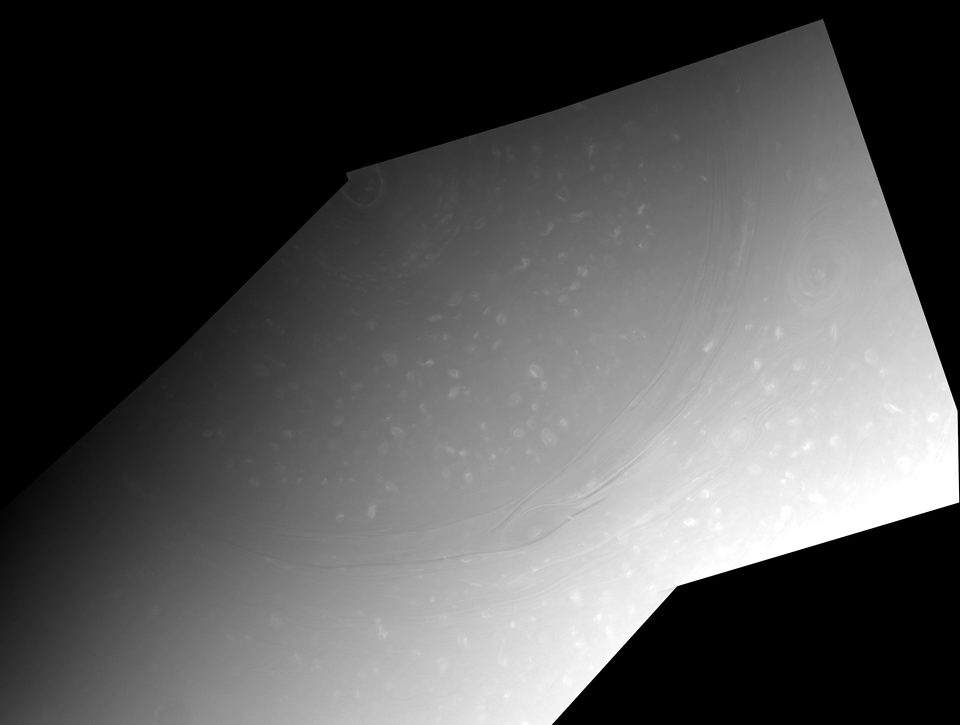

Astronomers using the Hubble Space Telescope have found a 10-sided wave pattern swirling around Saturn’s south pole, a feature that has no known precedent in the planet’s southern hemisphere. NASA’s Goddard Space Flight Center announced the result, which ScienceDaily carried on Thursday, and The Peninsula reported it the same day.
The finding is described in a paper in Science Advances, volume 12, issue 36, titled “A decagon wave around Saturn’s south pole,” according to ScienceDaily. The lead author is Agustín Sánchez-Lavega of the University of the Basque Country in Spain, and co-authors include Amy Simon of NASA Goddard and Michael Wong of the University of California, Berkeley. The sources do not name the study’s funders.
The pattern sits inside a powerful jet stream at about 63 degrees south latitude, The Peninsula reported, and each of its sides is more than 16,700 kilometers long. ScienceDaily described it as the first large, regularly shaped jet pattern seen in the southern hemisphere, and said it extends through several layers of the atmosphere. The Peninsula said it moves eastward at about 10 kilometers per hour.
The observations come from Hubble’s Outer Planet Atmospheres Legacy program, known as OPAL, which has imaged the giant planets every year for more than a decade. Faint early signs appear in Hubble data going back to 2023, ScienceDaily reported. Amateur astronomers spotted a wavy band in 2024 images, and ground-based observations in 2025, including images from a virtual observatory at the University of the Basque Country, gave stronger evidence. The Peninsula added that the European Southern Observatory’s Very Large Telescope in Chile was used to measure winds in the decagon.
The obvious comparison is Saturn’s north polar hexagon. “The northern hexagon has been there every time we’ve looked for more than 40 years,” Simon said, in the NASA account carried by ScienceDaily. The southern feature looks different. The Peninsula said it appears less stable than the hexagon and seems to be strengthening, and ScienceDaily noted that the Cassini spacecraft, which orbited Saturn from 2004 to 2017, showed no sign of a long-lived southern counterpart.
No one knows what produced the pattern or whether it will last. Sánchez-Lavega suggested that instability in the jet stream, or a wave rising from deeper in the atmosphere, could be responsible, The Peninsula reported. “We’ve never seen anything quite like this in Saturn’s southern hemisphere,” Simon said, and Leigh Fletcher of the University of Leicester, a co-author, said, “Saturn still has the ability to surprise us.”
ScienceDaily reported that further Hubble and James Webb Space Telescope observations and computer modeling are planned. Those should show whether the decagon persists.
Sources
- ScienceDaily (NASA Goddard release), Sept. 3, 2026: the decagon wave, the Science Advances paper and authors, the OPAL program and timeline, Simon’s quote on the hexagon, Cassini, planned observations <https://www.sciencedaily.com/releases/2026/09/260903064229.htm>
- The Peninsula, Sept. 3, 2026: latitude, side length and drift speed, use of the Very Large Telescope, stability compared with the hexagon, possible causes, quotes from Simon and Fletcher <https://thepeninsulaqatar.com/article/03/09/2026/saturn-has-a-new-mystery-scientists-discover-giant-10-sided-shape-at-south-pole>
This article was drafted with automated tools from the sources listed, checked by a review pass, and published by Daniel Varrone. Corrections: editor@monochromechronicles.com