The Fossil Sold for $47 Million Sits at the Center of a Dinosaur Argument
Whether Nanotyrannus was its own species or a young Tyrannosaurus rex has shifted in recent studies, and a Montana skeleton named Jodi is part of the story.
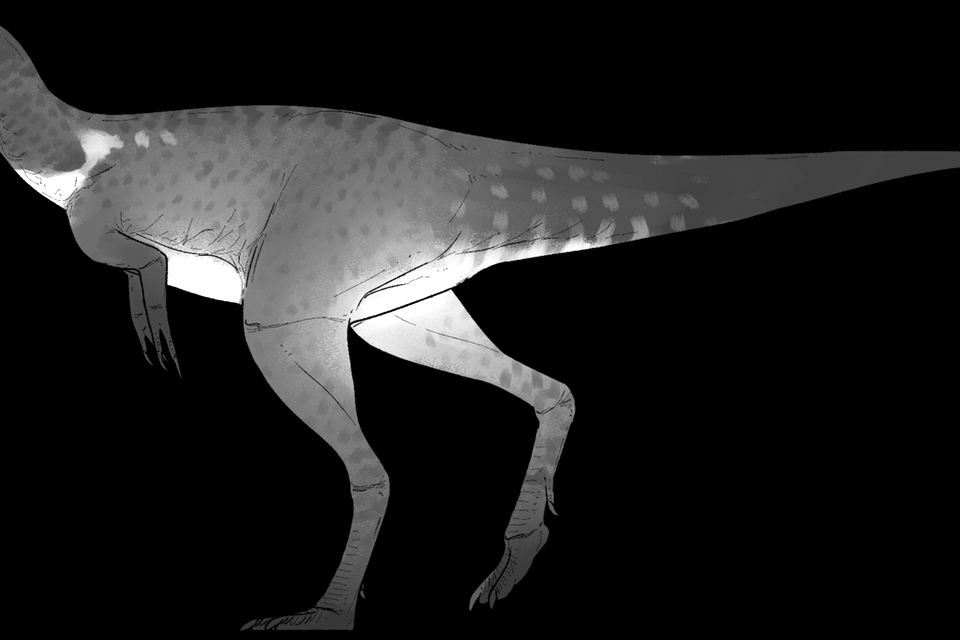

A nearly 20-foot-long skeleton named Jodi, sold at Sotheby’s in New York on Tuesday, belongs to a dinosaur whose identity scientists have argued about for decades. Nanotyrannus, a small, slender tyrannosaur from the Hell Creek Formation of the late Cretaceous, was long thought by many paleontologists to be a juvenile Tyrannosaurus rex. Recent research has pushed the other way.
The question matters because young animals change as they grow. Teenage tyrannosaurs, the argument went, would have had lighter skulls and more teeth than adults. If small specimens were simply juveniles, there was no separate species to name. The test is whether the small fossils show signs of being fully grown.
Two studies published in the past year have pressed that case. In December, a paper in Science led by Christopher Griffin of Princeton examined the throat bone of a well-known small skull and concluded that the animal was nearly fully grown when it died, which he said showed it was different from T. rex. Earlier, a Nature paper by Lindsay Zanno and James Napoli studied the so-called Dueling Dinosaurs specimen, a nearly adult tyrannosaur from Hell Creek, and supported Nanotyrannus as a distinct genus. That paper also proposed a second species name, Nanotyrannus lethaeus, which is more contested and should be treated as a claim rather than settled fact, according to summaries of the work.
Jodi was found in 2019 on a Montana ranch by rancher Jodi Pierson, for whom it is named. Sotheby’s lists 191 bone elements, including a nearly complete skull, and calls it one of only three known Nanotyrannus skeletons. The Associated Press described it as almost 70 percent complete, while Popular Science put the figure at about 55 percent. Forbes Argentina reported that the skeleton was shown in London in 2023 under a different name, as a possible juvenile T. rex, a sign of how quickly the classification has shifted.
The question may not be closed for every researcher. Researchers who favored the juvenile hypothesis may point out that few specimens exist to test, and the proposed second species name is itself contested. A skeleton as complete as Jodi’s could help, since an extensive set of bones allows researchers to look at growth rings and skull structure in the same animal.
That is where the sale’s scientific interest lies. The price will be discussed elsewhere; what matters to paleontologists is whether a buyer lets researchers study the skeleton. The buyer has not been identified, and Sotheby’s has not said whether access has been arranged.
Whatever Jodi’s new owner decides, the broader lesson is that classification in paleontology is a hypothesis tested bone by bone. Two independent lines of evidence now point the same direction, and the next test will come from whoever is given the chance to examine the rare specimens that remain.
Sources
- Associated Press via Phys.org, Oct 27, 2026: Jodi sells for $47.3 million; almost 70 percent complete; found in 2019 by rancher Jodi Pierson; one of three known skeletons
- Popular Science, Oct 2026: Jodi estimated at about 55 percent complete, nearly complete skull, nearly 20 feet long
- IFLScience, Oct 7, 2026: Sotheby’s listing of Jodi with 191 bone elements and a nearly complete skull
- Forbes Argentina, 2026: the skeleton was shown in London in 2023 as a possible juvenile T. rex before being renamed Jodi
- Science News, Dec 2025: Nanotyrannus still not a teenage T. rex; Science paper on hyoid bone
- Phys.org, Dec 2025: Nanotyrannus was not a juvenile T. rex, new study confirms; Griffin of Princeton
- University of Nebraska-Lincoln research blog, 2025: study confirms Nanotyrannus as a distinct species; Zanno and Napoli, Nature
This article was drafted with automated tools from the sources listed, checked by a review pass, and published by Daniel Varrone. Corrections: editor@monochromechronicles.com